

Early Contractor Engagement (ECE) can make a significant difference to the successful delivery of a construction project. However, it shouldn’t be limited to just those involved in the initial construction – end users, the people who will care for the building after practical completion, can also improve outcomes.
The problem with the current approach
For me a successful building is a building that can be cleaned, inspected, maintained, and repaired from day one.
My work is generally focused on the building envelope, and I am too often surprised to come across, or hear about, brand new buildings that have inaccessible areas of the façade or roofs, or details that create safety concerns for the people who need to access these areas. These issues can and should be designed out, but to do so would require engagement with the consultants and contractors who take over caring for a building once it is up and running.
End User Engagement (EUE) in action
Last year I was lucky enough to witness the positive outcomes that can come from end user engagement. My client was keen to understand what maintenance of their façade (which was under construction) would look like. They gave me the opportunity to review the design of the façade and the proposed access installations. I was also allowed to engage with an abseil maintenance contractor to benefit from their expertise.
It’s fair to say we were a bit late to the party, and installation was well underway by the time we started our review, but the developer (who was the main contractor) fully embraced the process. The developer had a desire for their building to be the best it could be throughout its life. So, when we presented our review findings, they listened and set about making changes to ensure the façade could be cared for effectively.
Key project wins
- External Corners
What looks like a 5mm gap on a shop drawing, where aluminium edges come together, is often a far bigger gap once installed. The problem with these gaps, and sharp edges, is they can catch ropes and cut ropes. It’s not feasible for abseilers to install rope protectors on every length of rope, and they can’t always prevent ropes getting snagged in the gaps.
The façade manufacturer took our comments onboard and created an elegant corner flashing.


2. Abseil Access System
The presence of louvres on the façade, that were not designed to be loaded by the weight of abseilers, required the use of needles mounted on an A-frame which connects to an anchor rail. However, this type of system can create dead spots where the rail position and spread of the A-frame prevent full abseil access.
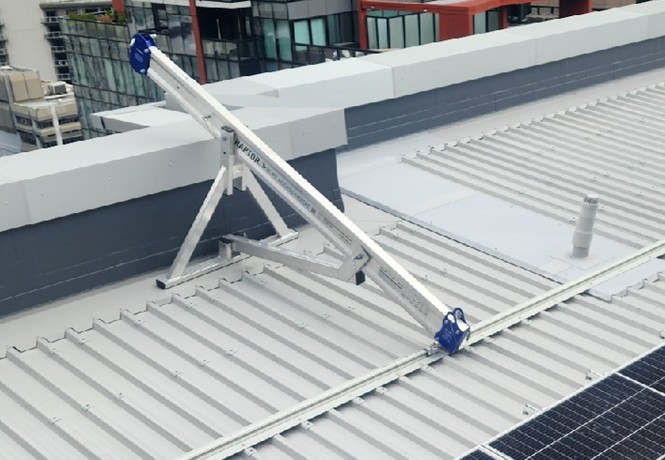
Despite façade manufacturer guidelines often recommending a different 10% of the façade is inspected each year, there is a tendency for access design to focus more on just cleaning. Telescopic extenders used by abseil cleaners may get the extremities cleaned, but what about inspecting and maintaining those areas?
The developer and the site engineer were able to alter aspects of the roof level steelwork design to allow installation of davit arms at corners, removing the dead spots.
3. Abseil Deviations
Large deck areas had been designed lower down the building and the façade stepped out from the main façade plane in these areas. The abseil façade contractor noted that this would not be safe as abseilers would be too far away from their anchor point.
Again, the developer and site engineer took onboard the comments, and managed to alter the balustrade steelwork to include rated anchors the abseilers could use as deviations when they reached this section of the façade.
Recommendations for implementation
Dialogue between the developer, designers, engineers, and end users (building surveyor and abseil maintenance contractor, in this instance) were critical in identifying the required alterations. The outcome is a façade which is almost fully accessible by abseil and will also be safer for the abseil team.
A building that can be maintained effectively and safely has a far better chance of performing at its best and standing the test of time. We should want this for all buildings, and we can achieve it by expanding ECE to include End User Engagement (EUE).
By Victoria Richardson

 Copper Seed